Kevru
Claude Code · Codex · Cursor · any MCP agent

Your agents work.
You make the call.

Kevru gives every project one plain Markdown file where agents check in: post status, claim work, ask you questions. When one needs a decision, your phone buzzes with the options. Tap one. The agent keeps going.

Real session, Oct 23 2026asked 07:53answered from a phone 07:54
~/Developer/tpg-private — claude
Friday, October 23
7:53
Kevrunow
tpg-private · claude-code needs you
Should we ship the pricing page today?
Ship it
Hold
Replied ✓
docs/huddle.md· tpg-privateplain Markdown, in your repo

      
Re-creation of a real session on one of our projects. The terminal lines and the Markdown are what Kevru wrote, verbatim.
Five-minute setup

Three commands. No servers, no accounts, no dashboard to babysit.

STEP 1

Make a folder a project

huddle add . creates docs/huddle.md and appends a short check-in protocol to your CLAUDE.md or AGENTS.md. Nothing is overwritten.

STEP 2

Connect your agent tool, once

huddle install claude-code registers the MCP server at user scope. Codex and Cursor get a config snippet. The next session in any project has the tools.

STEP 3

Answer from anywhere

Questions arrive on your phone through the free ntfy app with up to three one-tap options. Or answer from the dashboard, or huddle answer Q3 "60 min" in a terminal.

The file

It's a Markdown file. That's the whole database.

Four sections Kevru manages. Anything else you write in the file stays exactly where you put it.

  • Lives in your repo. Diff it, review it, grep it. Teammates' agents check in to the same file.
  • Nothing app-specific. No ids in comments, no sidecar database. Delete Kevru and the file is still a useful file.
  • Agents can't forge it. Agents get six narrow tools and no "write anything" tool. Pasted Markdown is escaped, so an agent can't close its own question or rewrite the board.
  • Safe under load. Atomic writes behind a lock. Twelve agents posting at once lose nothing.
docs/huddle.md
# Huddle · shot-lab

## Status
state: awaiting-human
updated: 2026-10-22 21:40
note: builder-2 is waiting on Q3

## Questions
### Q3 · builder-2 · 2026-10-22 21:40 · open
Rim detection v3 needs 400 more labeled clips.
Label in-house (2 days) or send out ($380)?
Options: In-house | Send out | Hold

## Board
- [ ] **B3** rim detection model v3 _(claimed by builder-2 · 21:30)_
- [x] **B2** camera calibration pipeline _(done by builder-1 · 20:40)_

## Log
- 21:40 · builder-2 · asked Q3: Rim detection v3 needs…
- 21:30 · builder-2 · claimed B3 rim detection model v3
- 20:40 · builder-1 · finished B2 — PR #41
What agents get

Six tools. Each one does a small thing well.

huddle_read

State, open questions, the board, recent log. Agents call it first, so they see the answer you already gave and the work someone else already claimed.

huddle_claim

Claim a piece of work before starting it. If another agent holds it, the tool says so. No duplicate work.

huddle_post

One-line status: what got done, where it is. Optionally sets the project state.

huddle_done

Mark a board item finished with a pointer to the result ("PR #41").

huddle_ask

Ask you a question with up to three options. The options become buttons on your phone.

huddle_wait_for_answer

Block until you answer, from the phone, the dashboard or the terminal. Claude Code parks it in the background and keeps working.

What they don't get: a way to edit the file. Answering is a human action, through the CLI, the dashboard or the phone. The agent that asked can't answer itself.

Why I built it

You don't have to control every play to lead the team.

I've coached basketball for years. You can't make every decision for every player, and you shouldn't. Players read the game and make plays. But there are moments when they need you: a question, an adjustment, a call that isn't theirs to make. They look to the bench, get the call, and keep playing.

Coding agents are the same. They can write code and work across projects all day. But when one needs a decision, it guesses, or it stops, and you don't find out until you open the right terminal window.

So I built the thing I wanted: one Markdown file where agents check in, and a buzz on my phone when one needs me. I make the call. The answer lands in the file and the agent gets back to work.

You just have to be there when your decision matters.

Lee Green
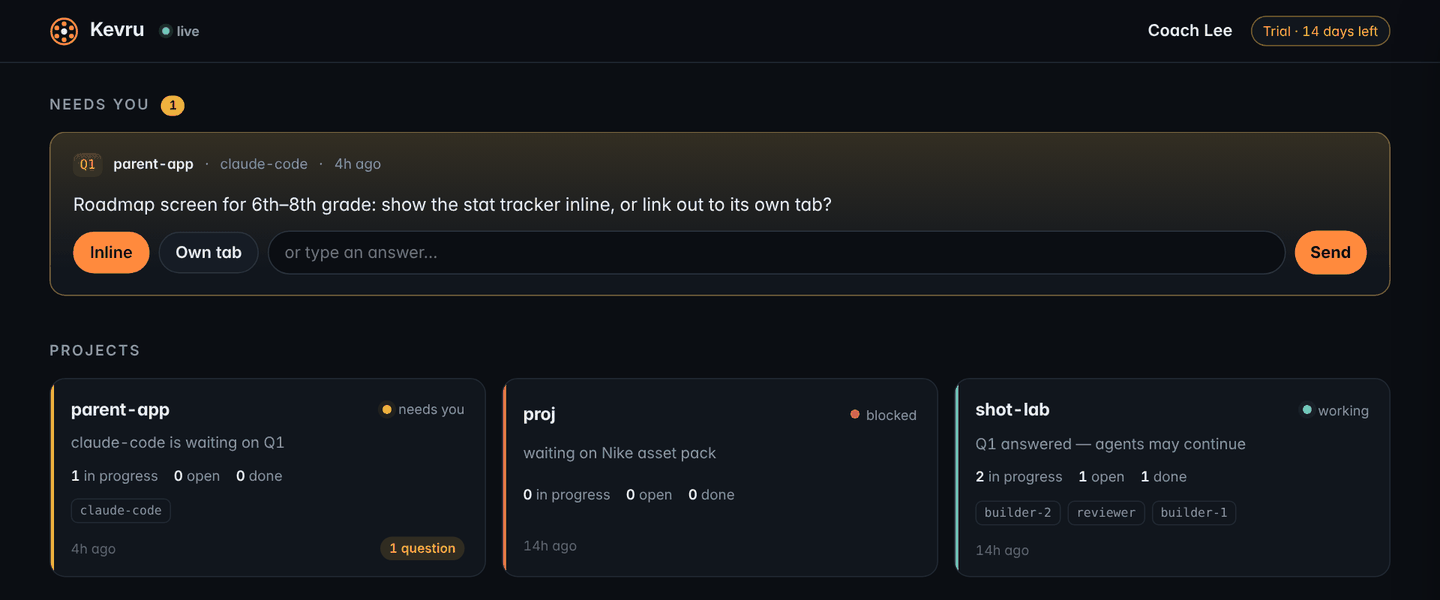
What you get

One screen for every project, and who needs you right now.

Kevru dashboard: a Needs-you card with a question and two option buttons, above three project cards showing state, in-progress counts and agent names

The dashboard runs on your machine at 127.0.0.1, reads the Markdown on every request, and updates live when a file changes. Answer in the browser or type a note for the agents. The CLI covers the same ground: huddle list, huddle inbox, huddle answer.

Pricing

Pay once. Keys work offline. Your files are never held hostage.

Launch · first 100
$79once
One person, forever. Every future 1.x update.
  • Perpetual license key
  • All features, all agents
  • Email support
Get the launch deal
Solo
$49/ year
One developer, one machine.
  • All features
  • Updates while active
  • Email support
Choose Solo
Team
$199/ year
Up to 5 machines in one organization.
  • Everything in Solo
  • Shared huddle files via git
  • Priority support
Choose Team
Site
$699/ year
Up to 25 machines. Agencies and departments.
  • Everything in Team
  • Self-hosted ntfy guidance
  • Invoice billing
Choose Site

Every install starts with a 14-day trial of every feature, no card. License keys are signed and verified on your machine; Kevru has no license server and never phones home. If a key lapses, the agent tools pause after a 7-day grace period. Reading and editing your Markdown always works, because it's your file.

Questions

Straight answers.

Does anything leave my machine?

Only the notification you configured. Kevru pushes through ntfy, a free open-source push service with iPhone and Android apps. Topic names are long random strings. If you want it fully private, point Kevru at a self-hosted ntfy server or add an access token; both take one flag.

Which agents work with it?

Claude Code is the most tested. Codex and Cursor connect with a config snippet Kevru prints for you. Anything that speaks MCP over stdio works the same way.

What happens while the agent waits for me?

Claude Code moves the waiting call to a background task after about two minutes and keeps working on other things. Kevru sends progress every few seconds so the connection never idles out. When you answer, the agent picks it up within about five seconds.

What if two agents try to do the same thing?

The second claim fails with "already claimed by builder-1." That's the point of the board. Give each agent its own name and the log reads like a team channel.

Mac, Linux, Windows?

All three. Node 20.11 or newer. The macOS banner notification is a bonus; the phone push works everywhere.

What if I stop paying?

Your files are plain Markdown in your repo and stay that way. The agent write tools pause after the grace period. Reading, the CLI and the dashboard keep working. A lifetime key never pauses.